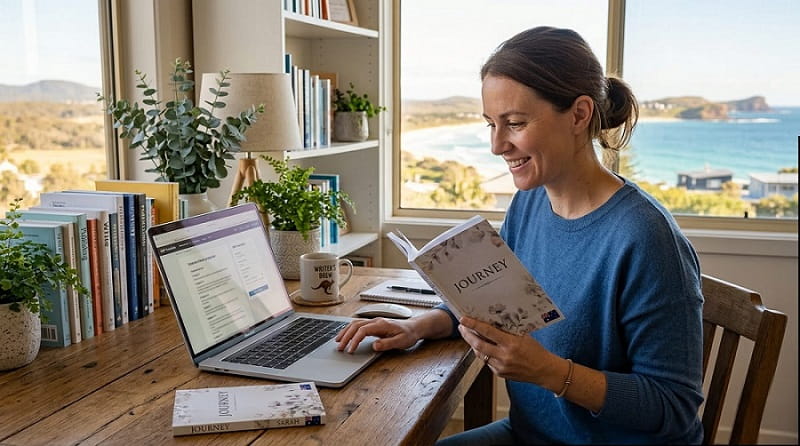
Let's be real for a second. If you've spent months (or years) pouring your heart into a manuscript, only to hit a wall of confusing publishing jargon, platform choices, and unanswered questions about ISBNs and royalties, you're not alone. Thousands of Australian writers find themselves stuck in that exact spot, wondering how to self-publish a book without losing their minds or their savings in the process.
The traditional publishing route has its perks, sure, but it also comes with gatekeepers, long wait times, and the very real possibility of rejection letters piling up while your story gathers dust. Self-publishing flips that script entirely. It puts you in the driver's seat. You choose the cover. You set the price. You keep a significantly larger share of the royalties. And the best part? You don't need anyone's permission to share your story with the world, or explore professional ghostwriting assistance.
This guide exists because most self-publishing advice out there is written with American or British authors in mind. And while the fundamentals overlap, Australian authors face a unique set of circumstances. From purchasing ISBNs through Thorpe-Bowker to understanding how platforms like IngramSpark and KDP serve the Australian market, there are critical details that generic guides gloss over entirely.
At Melbourne Print and Publish, we work with Australian authors every day. We've seen first-hand what trips people up and what makes the difference between a book that sits unnoticed and one that actually reaches readers. So we've put together this comprehensive, no-nonsense guide to walk you through every stage of self-publishing a book in Australia, from manuscript preparation right through to marketing and distribution.
Whether you're a first-time novelist, a memoirist, or someone who's been sitting on a collection of short stories for years, or seeking non-fiction ghostwriting service, this guide will give you the clarity and confidence to finally get your book out into the world. No fluff. No vague advice. Just practical, actionable steps tailored specifically for Aussie authors.
Before we dive into the mechanics of how to self-publish, it's worth taking a moment to understand the space you're stepping into. Australia's book market is smaller than the US or UK, but that's not necessarily a disadvantage. In fact, it can work in your favour.
The Australian reading community is tight-knit, passionate, and genuinely supportive of local voices. Independent bookstores still hold significant sway, literary festivals are well-attended, and readers here actively seek out homegrown stories. That means if you position your book well, you've got a receptive audience waiting.
Self-publishing in Australia comes with its own set of quirks. For starters, the ISBN system operates differently here than in the US, where Amazon will hand you a free one. In Australia, you purchase your ISBNs through Thorpe-Bowker, the country's official ISBN agency. This gives you more control but also means there's a cost involved, which we'll break down later.
Then there's the question of distribution. While Amazon dominates globally, Australian readers also shop through Booktopia, Dymocks, and independent bookshops. If you only publish through KDP, you're essentially invisible to a large chunk of the local market. That's where platforms like IngramSpark become essential for any author serious about self-publishing a book in Australia.
Organisations like the Australian Society of Authors (ASA) and Writers Victoria offer valuable resources, networking opportunities, and advocacy for indie authors. If you haven't already, it's worth checking them out early in your journey.
There's a lingering stigma around self-published books, and let's address it head-on. The old assumption that self-publishing equals low quality simply doesn't hold up anymore. Some of the most commercially successful books of the past decade started as self-published titles. The difference between a self-published book that looks amateur and one that sits comfortably on a bookstore shelf comes down to the effort you put into editing, design, and formatting.
Self-publishing isn't the easy route. It's the independent route. You're running a small business, and the quality of your product reflects directly on you. But the payoff, both creatively and financially, can be extraordinary if you approach it with the right mindset.
Here's a truth that every successful self-published author will tell you: writing the book is only half the battle. The other half is editing it until it shines.
No matter how talented you are as a writer, you cannot effectively edit your own work. You're too close to it. You know what you meant to say, so your brain will fill in gaps, smooth over awkward phrasing, and skip right past plot holes. A professional editor catches what you can't.
Think about the last time you picked up a book riddled with typos, clunky sentences, or a plot that didn't quite hang together. Did you finish it? Probably not. And you almost certainly didn't leave a glowing review. Readers are unforgiving when it comes to quality, and in the self-publishing space, your book's polish is your credibility.
Poor editing leads to poor reviews. Poor reviews lead to poor sales. And once a book earns a reputation for being unpolished, it's incredibly difficult to recover from that.
There are three main stages of editing, and understanding the difference will help you decide where to invest your budget.
Developmental editing is the big-picture stuff. This is where an editor looks at your story's structure, pacing, character arcs, and overall narrative coherence. If your plot sags in the middle or your protagonist feels flat, a developmental editor will flag it and help you reshape the manuscript. This stage is particularly valuable for first-time authors who may not yet have a strong sense of story architecture.
Copy editing comes next. This is the line-by-line work, addressing grammar, syntax, punctuation, consistency, and clarity. A copy editor ensures your writing is clean, your tenses don't wander, and your character's name doesn't mysteriously change spelling halfway through chapter twelve.
Proofreading is the final pass. It catches the last remaining typos, formatting inconsistencies, and minor errors that slipped through earlier rounds. Even if you can't afford a full developmental edit, investing in at least a professional proofread is absolutely essential.
If you're looking for editors based in Australia, the Institute of Professional Editors (IPEd) maintains a directory of accredited professionals. Platforms like Reedsy and Upwork also connect you with freelance editors, many of whom specialise in specific genres.
When vetting an editor, always ask for a sample edit. Most reputable editors will edit a few pages for free or at a reduced rate so you can gauge whether their style and approach suit your manuscript. Check their references, look at books they've worked on, and make sure their experience aligns with your genre.
Budget-wise, professional editing in Australia typically ranges from a few hundred dollars for a basic proofread to several thousand for a comprehensive developmental edit. It's one of the biggest expenses in self-publishing, but it's also the one that has the most direct impact on your book's quality and reception.
You've heard it a thousand times: don't judge a book by its cover. And yet, every single reader does exactly that. Your cover is the first thing a potential buyer sees, whether they're scrolling through Amazon, browsing a bookshop shelf, or spotting your book on social media. It has roughly three seconds to grab attention, communicate genre, and make someone curious enough to read the description.
A great cover doesn't just look pretty. It works as a marketing tool. It tells the reader instantly what kind of book they're picking up. Romance readers expect certain visual cues. Thriller readers expect others. Fantasy covers signal something else entirely. If your cover doesn't match reader expectations for your genre, you'll struggle to sell copies regardless of how brilliant the writing is.
Spend some time browsing the bestseller lists in your genre. Look at the covers of books that are selling well and notice the patterns. What colours dominate? What style of typography is common? Are there illustrated elements or photographic images? This isn't about copying anyone. It's about understanding the visual language your target readers respond to.
Your cover needs to stand out, but it also needs to fit in. That sounds contradictory, but it's the reality of book marketing. A cover that looks wildly different from everything else in its genre might be eye-catching, but it can also confuse readers about what they're getting.
Unless you have genuine graphic design experience, this is not the place to cut corners. A professionally designed cover is one of the best investments you can make in your book. Look for designers who have experience in your specific genre and whose portfolio demonstrates range and quality.
You can find talented cover designers through platforms like Reedsy, or by searching for Australian-based freelance designers who understand the local market. Pre-made covers are also an option if your budget is tight. These are professionally designed covers that haven't been used before, and they're available at a fraction of the cost of a custom design.
In terms of cost, custom cover design in Australia generally runs between $300 and $1,500, depending on the complexity and the designer's experience. Pre-made covers can be found for as little as $50 to $200. Tools like Canva or Adobe Photoshop can be useful for minor refinements, but for the primary cover design, professional expertise makes a noticeable difference.
Formatting is the part of self-publishing that doesn't get nearly enough attention, and yet it can make or break the reading experience. A beautifully written, professionally edited book can still feel amateurish if the interior layout is sloppy. Inconsistent fonts, wonky margins, missing page numbers, or chapters that start mid-page all scream "self-published" in the worst possible way.
The formatting requirements for eBooks and print books are fundamentally different, and you'll need to address both if you plan to publish in multiple formats, including using e-book writing services.
eBook formatting needs to be responsive. Readers adjust font sizes, switch between devices, and read in both portrait and landscape modes. Your eBook file needs to flow smoothly regardless of how the reader chooses to view it. The standard file formats are EPUB (for most platforms) and MOBI or KPF (for Amazon's Kindle ecosystem).
Print formatting is about fixed layout. You're designing for a specific trim size with precise margins, gutters, headers, footers, and page numbers. The interior needs to look clean and professional, with consistent typography and proper chapter openings.
Two pieces of software dominate the self-publishing formatting space: Vellum and Atticus. Vellum is Mac-only and is widely regarded as the gold standard for producing beautiful eBook and print interiors with minimal effort. Atticus is a newer, cross-platform alternative that offers similar functionality and works on both Mac and Windows.
Both tools allow you to import your manuscript, apply professional templates, and export files ready for upload to publishing platforms. If software isn't your thing, hiring a professional formatter is another solid option. Expect to pay somewhere between $100 and $500 for formatting services, depending on the length and complexity of your book.
Watch out for widow and orphan lines (single lines stranded at the top or bottom of a page), inconsistent spacing between paragraphs, and font choices that are difficult to read. Test your eBook file on multiple devices before publishing, and always order a proof copy of your print book to check the physical layout before making it available for sale.
This is where self-publishing in Australia diverges significantly from the process in the US or UK, and it's one of the most common areas of confusion for new authors.
An ISBN (International Standard Book Number) is a unique 13-digit identifier assigned to each edition and format of a book. Think of it as your book's fingerprint in the global publishing ecosystem. It's how bookstores, libraries, distributors, and online retailers identify and catalogue your work.
Every distinct format of your book needs its own ISBN. Your paperback gets one. Your hardcover gets another. Your eBook gets a separate one. And if you release a significantly revised edition, that needs a new ISBN too.
The ISBN also determines who is listed as the publisher of record. If you use a free ISBN provided by Amazon through KDP, Amazon appears as the publisher. If you purchase your own ISBN, you are listed as the publisher, which gives you greater control over your book's metadata and professional standing.
In Australia, ISBNs are purchased exclusively through Thorpe-Bowker, the country's official ISBN agency. Unlike the US, where ISBNs are bought through Bowker at relatively steep prices, and unlike some countries that offer free ISBNs, Australia sits somewhere in between.
You can purchase ISBNs individually or in blocks. Buying in bulk is more cost-effective if you plan to publish multiple books or multiple formats. The process is straightforward: you create an account on the Thorpe-Bowker website, select the number of ISBNs you need, complete the purchase, and then assign each ISBN to the appropriate edition of your book with the correct metadata.
One of the biggest mistakes new authors make is reusing an ISBN across different formats. Your paperback and your eBook are different products and must have different ISBNs. Another common error is entering incorrect metadata when registering your ISBN, which can cause problems with distribution and discoverability down the line.
Once your book is published, you're also required to deposit copies with the National Library of Australia under the Legal Deposit scheme. This is a legal obligation for all books published in Australia, and it ensures your work is preserved as part of the national collection.
This is where strategy becomes critical. The platform (or combination of platforms) you choose will determine where your book is available, how it reaches readers, and how much you earn per sale. There's no single right answer here, but there are definitely wrong ones, and the biggest mistake is limiting yourself to just one platform without understanding the trade-offs.
How to self-publish a book effectively comes down to matching your goals with the right distribution strategy. Are you primarily targeting Australian readers? Do you want your book in physical bookstores? Are you focused on eBook sales? Your answers shape your platform choices.
KDP is the 800-pound gorilla of self-publishing. It offers both eBook and print-on-demand publishing, has the largest market share globally, and provides a straightforward upload and publishing process. For eBooks, you can earn up to 70% royalties on books priced between $2.99 and $9.99 USD. Print royalties are calculated after deducting printing costs.
The platform is easy to use, has robust advertising tools (Amazon Ads), and gives you access to the world's biggest online bookstore. The downside? KDP's print distribution is largely limited to Amazon itself. Your book won't show up in Dymocks or your local indie bookshop through KDP alone.
KDP also offers an exclusivity programme called KDP Select, which enrols your eBook in Kindle Unlimited. This can boost visibility and earnings through page reads, but it means you can't sell your eBook anywhere else while enrolled. For many Australian authors, this trade-off isn't worth it, especially if you want broad distribution.
If you want your print book to be available in bookstores, libraries, and through traditional distribution channels, IngramSpark is essential. Ingram is the world's largest book distributor, and IngramSpark is their self-publishing arm. When a bookstore orders a copy of your book through their usual suppliers, it's Ingram's network that fulfils that order.
IngramSpark is particularly important for Australian authors because it connects you to the local distribution infrastructure. Without it, getting your book into Australian bookstores is extremely difficult. The platform handles both print and eBook distribution, though it's primarily valued for its print capabilities.
The setup is more complex than KDP, and there are fees for making revisions to your files after upload. But for serious authors who want professional-level distribution, it's a necessary part of the equation.
For comprehensive eBook distribution beyond Amazon, these three platforms cover most of the remaining market. Kobo has a strong presence in Australia and Canada. Apple Books reaches the massive iOS user base. Google Play Books offers broad global reach.
Each platform has its own royalty structure (generally between 45% and 70%) and its own upload process. Publishing across all of them ensures that readers can find your eBook regardless of which device or ecosystem they prefer.
| Platform | Formats | Reach / Distribution | Royalty Structure | Key Strengths | Key Limitations | Best Use Case |
|---|---|---|---|---|---|---|
| Amazon Kindle Direct Publishing (KDP) | eBook, print-on-demand | Amazon global marketplace | Up to 70% on eBooks | Largest audience, simple setup | Limited print distribution outside Amazon | Maximising Amazon sales |
| IngramSpark | Print-on-demand, eBook | Global bookstore, library, retail distribution | Wholesale model | Essential for bookstore/library access | Setup complexity, fees for revisions | Physical bookstore presence |
| Kobo Writing Life | eBook | Kobo store (strong in Australia, Canada) | Typically up to 70% | Strong international reach outside Amazon | Smaller market share than Amazon | Expanding eBook reach beyond Amazon |
| Apple Books | eBook | Apple ecosystem globally | Around 70% | Premium audience, strong integration | Less discoverability outside Apple users | Reaching Apple-heavy readership |
| Google Play Books | eBook | Android devices, Google ecosystem | Typically 70% | Wide Android reach, good discoverability | Less curated storefront | Broad global distribution |
The most effective approach for most Australian authors is a combination strategy. Use KDP for your Amazon presence (both eBook and print-on-demand). Use IngramSpark for wider print distribution, especially into Australian bookstores and libraries. And publish your eBook through Kobo, Apple Books, and Google Play to capture readers across all major platforms.
This multi-platform approach maximises your reach without locking you into exclusivity with any single retailer.
Pricing is part art, part science, and part gut instinct. Get it right and you'll find the sweet spot between volume and profit. Get it wrong and you'll either leave money on the table or price yourself out of the market entirely.
Australian book prices tend to sit slightly higher than US prices, partly due to the smaller market and partly due to higher production and shipping costs. Before you set your price, spend time researching what comparable books in your genre are selling for on Australian storefronts. Look at both traditionally published and self-published titles to get a realistic picture.
eBook pricing is where you have the most flexibility. Most self-published eBooks in popular genres are priced between $2.99 and $6.99 AUD. At the lower end, you benefit from higher volume. At the higher end, you earn more per sale but may move fewer copies.
Introductory pricing is a common launch strategy. Setting your eBook at $0.99 or even free for a limited period can generate downloads, reviews, and visibility in the crucial early days after publication. Once you've built some momentum and accumulated reviews, you can raise the price to a more sustainable level.
If you're enrolled in KDP Select, you can also use Kindle Countdown Deals and Free Book Promotions to drive periodic spikes in visibility and downloads.
Print pricing is less flexible because you need to account for the physical cost of printing each copy. Both KDP and IngramSpark provide calculators that show you the minimum price based on your book's specifications (page count, trim size, colour vs. black and white interior).
For IngramSpark, you'll also need to set a wholesale discount for retailers. Most bookstores expect a discount of 40% to 55% off the retail price. Setting your discount too low means bookstores won't stock your book. Setting it too high eats into your margins. A 55% discount with returnability enabled gives you the best chance of bookstore placement, but your per-copy earnings will be modest.
The key is to price competitively within your genre while ensuring you're actually earning something meaningful on each sale. Run the numbers carefully before you commit.
Here's the part that makes most writers uncomfortable. You've written the book. You've edited it, designed a gorgeous cover, formatted the interior, sorted your ISBN, and uploaded to your chosen platforms. Now you need people to actually find it and buy it.
The uncomfortable truth about self-publishing is that nobody is going to market your book for you. There's no publishing house with a marketing department handling your launch. It's all on you. But that's also the beauty of it. You have direct access to your readers, complete control over your messaging, and the ability to pivot your strategy in real time.
Your author platform is everything that connects you with potential readers. It includes your website, your social media presence, your email list, your blog, and your reputation within the writing and reading community.
Start building this before your book is published. Ideally, start while you're still writing. Share your journey. Talk about the themes in your book. Engage with readers in your genre. By the time launch day arrives, you want an audience that's already invested in your success.
An author website doesn't need to be complicated. A clean, professional site with an about page, a page for your book (or books), a blog, and a way for readers to sign up for your email list covers the essentials. Your email list is, without question, your most valuable marketing asset. Social media algorithms change constantly, but an email list is something you own and control.
Instagram, Facebook, and TikTok (particularly BookTok) are the primary social media platforms for book marketing right now. Each has its own culture and best practices, so pick the one or two where your target readers are most active and focus your energy there rather than trying to be everywhere at once.
The key to effective social media marketing is consistency and authenticity. Share content that's genuinely interesting or useful, not just "buy my book" posts. Behind-the-scenes glimpses of your writing process, book recommendations in your genre, thoughts on craft, and personal stories all help build a connection with your audience.
Australia has a vibrant community of book bloggers, bookstagrammers, BookTokers, and literary influencers. Identifying and building relationships with these people can be incredibly valuable for getting your book noticed.
Reach out to reviewers who cover your genre and offer them a free copy in exchange for an honest review. Be professional, personalised, and respectful of their time. Don't spam every reviewer you can find with a generic mass email. Targeted, genuine outreach works far better.
Australian libraries and literary festivals are also worth engaging with. Many libraries are open to stocking self-published books, particularly from local authors, and literary festivals often feature sessions and panels relevant to indie publishing.
Paid advertising can accelerate your book's visibility significantly. Amazon Ads is the most directly effective advertising platform for book sales because you're reaching people who are already on Amazon looking to buy books. The learning curve is moderate, but the targeting options (by genre, by comparable authors, by keywords) are powerful.
Facebook and Instagram ads are useful for building awareness and driving traffic to your website or retailer pages. They're particularly effective for building your email list, which pays dividends over the long term.
Start with a modest budget, test different approaches, and scale up what works. Advertising is an investment, and like any investment, it requires patience and a willingness to learn from what doesn't work.
Here's something that many new authors overlook entirely: metadata. Your book's title, subtitle, description, keywords, and category selections are how readers find you on retail platforms. Think of metadata as your book's SEO. If you choose the wrong categories or skip the keyword fields, you're essentially hiding your book from the people most likely to buy it.
Spend serious time crafting a compelling book description. This is your sales pitch. It should hook the reader, convey the tone and stakes of your story, and end with a reason to buy. Look at how bestselling books in your genre write their descriptions and model yours accordingly.
A strong launch doesn't happen by accident. Plan it out at least a month in advance. Build a launch team of early readers who can post reviews on day one. Coordinate social media posts, email announcements, and any promotional pricing. Consider a virtual book tour through book blogs and podcasts.
But remember that marketing doesn't stop after launch week. The most successful self-published authors treat marketing as an ongoing activity. They continue to engage with readers, run periodic promotions, experiment with advertising, and build their backlist. Publishing your second book is one of the most effective marketing strategies for your first.
Understanding how your book actually reaches readers and how you get paid is essential for making informed decisions about your publishing strategy.
For eBooks, distribution is relatively straightforward. When a reader purchases your eBook on Amazon, Kobo, Apple Books, or Google Play, the file is delivered digitally to their device. There's no physical inventory, no shipping, and no intermediary beyond the platform itself.
Print distribution is more complex. With print-on-demand through KDP or IngramSpark, books are printed individually as orders come in. There's no warehouse full of your books sitting somewhere. When a reader orders a copy, it's printed, bound, and shipped directly to them (or to the bookstore that ordered it).
IngramSpark's distribution network is what connects your book to traditional retail channels. When a bookstore wants to order your book, they do so through Ingram's catalogue, and Ingram handles the printing and fulfilment. This is why IngramSpark is so important for authors who want bookstore presence.
Royalty calculations vary by platform and format. For KDP eBooks, you earn either 35% or 70% of the list price, depending on the price point and the delivery costs. For KDP print, your royalty is the list price minus the printing cost minus Amazon's cut (typically 40%).
IngramSpark royalties depend on the wholesale discount you set. If your book retails for $20 and you offer a 55% wholesale discount, the wholesale price is $9. Subtract the printing cost (say $5), and your royalty is $4 per copy sold through retail channels.
Each platform has its own payment threshold and schedule. KDP pays monthly, approximately 60 days after the end of each month, once you've earned above the minimum threshold. IngramSpark pays monthly as well, with a 90-day delay. Payments to Australian authors are typically made via electronic funds transfer, and you'll need to ensure your tax information is correctly set up to avoid withholding issues.
This section isn't the most exciting part of self-publishing, but ignoring it can cause real headaches down the line. A bit of upfront attention to the legal and financial side saves you from unpleasant surprises later.
The good news is that in Australia, your work is automatically protected by copyright from the moment you create it. You don't need to register it anywhere or add a copyright notice (though including one in your book is standard practice and a good idea). Copyright protection lasts for the life of the author plus 70 years.
That said, keeping detailed records of your creative process, including dated drafts and correspondence, can strengthen your position if a dispute ever arises. If you're particularly concerned about protecting your intellectual property, consulting with a lawyer who specialises in IP is worthwhile.
Whether your writing income is classified as a hobby or a business matters significantly for tax purposes. The ATO looks at factors like whether you're operating with a genuine intention to make a profit, whether you've conducted business-like activities (marketing, maintaining records), and whether the activity is organised and systematic.
If your publishing activity is classified as a business, your income is assessable and you can claim deductions for expenses like editing, cover design, advertising, and software subscriptions. If it's classified as a hobby, you generally can't claim deductions, but you also don't need to declare the income (within certain limits).
Once your annual turnover from publishing exceeds $75,000, you're required to register for GST. While most self-published authors won't hit this threshold early on, it's worth being aware of, particularly if you're publishing multiple titles or earning income from related activities like speaking or workshops.
If you're operating your publishing activity as a business, you'll likely need an Australian Business Number (ABN). This is straightforward to apply for and is necessary for invoicing, dealing with other businesses, and managing your tax obligations. You can register as a sole trader, which is the simplest structure for most indie authors.
| Topic | Key Point | Details | Practical Implication for Indie Authors |
|---|---|---|---|
| Copyright (Australia) | Automatic protection | Copyright automatically granted upon creation; duration life of author + 70 years | Your manuscript is legally protected from the moment you write it; keeping a copyright notice is standard practice |
| Intellectual Property Protection | Evidence of ownership matters | Maintaining dated drafts, version history strengthens proof of authorship | Keep organised records of drafts and edits. Consider legal advice for complex cases |
| Hobby vs Business Classification (ATO) | Tax treatment depends on intent and structure | ATO assesses based on profit intention, organisation, commercial activity | If treated as a business, income is taxable but expenses are deductible |
| Deductible Expenses (Business Authors) | Only applies if operating as a business | Potential deductions include editing, cover design, marketing, software, publishing services | Keep receipts and financial records if you intend to claim publishing-related costs |
| GST Registration Threshold | Revenue-based requirement | GST registration mandatory once annual turnover exceeds $75,000 | Most beginner authors won't reach this early, but scaling authors must monitor income carefully |
| Australian Business Number (ABN) | Business identification number | Required if operating as a business; typically registered as a sole trader for indie authors | Needed for invoicing, working with service providers, and formal business operations |
| Record Keeping | Essential for compliance | Financial and creative records support tax reporting and legal protection | Maintain structured accounting records and separate publishing income/expenses from personal finances |
Important: this section provides general information only. Every author's financial situation is different, and you should consult with a qualified tax professional or accountant for advice specific to your circumstances.
If you've made it this far, you now have a clearer picture of what it takes to self-publish a book in Australia than the vast majority of aspiring authors out there. The process isn't simple, but it's absolutely doable. And the rewards, both personal and financial, can be genuinely life-changing.
Let's recap the path quickly. You start with a polished, professionally edited manuscript. You invest in a cover that communicates your genre and grabs attention. You format your interior to professional standards. You secure your ISBN through Thorpe-Bowker. You choose your platforms strategically, combining KDP for Amazon reach with IngramSpark for broader distribution. You price your book competitively. You build a marketing plan and an author platform. And you stay on top of the legal and financial side to keep everything running smoothly.
Self-publishing is not a shortcut. It's a different path, one that demands more of you as both a creative and a businessperson. But it's also a path that offers something traditional publishing rarely does: complete ownership of your work, your brand, and your career.
The Australian indie author community is growing rapidly, and there's never been a better time to be part of it. The tools are accessible. The platforms are mature. The readers are out there. The only missing piece is your book.
At Melbourne Print and Publish, we've helped countless Australian authors navigate this journey, and the one thing every successful self-published author has in common is that they started. They took the first step, even when it felt overwhelming, and they kept going.
Your story deserves to be told. Take these steps, trust the process, and bring your book to life. The Australian reading world is waiting for you.
Self-publishing involves preparing your manuscript through professional editing, designing a cover, formatting the interior for eBook and print, obtaining an ISBN, uploading to publishing platforms like KDP and IngramSpark, setting your price, and marketing your book to readers. This guide covers each of these steps in detail.
Self-publishing means you handle the publication of your book independently, without a traditional publishing house. You manage (or outsource) every aspect of production, from editing and design to distribution and marketing. You retain full creative control and earn a higher percentage of royalties than traditionally published authors typically receive.
Follow the steps outlined in this guide: edit your manuscript professionally, invest in a quality cover, format for your chosen platforms, obtain your ISBN (through Thorpe-Bowker if you're in Australia), upload to platforms like KDP and IngramSpark, price strategically, and build a marketing plan to reach your target readers.
Absolutely. That's exactly what self-publishing is. You become your own publisher. You can produce a book that's every bit as professional as a traditionally published title, provided you invest in quality editing, design, and formatting.
Costs vary widely depending on the level of professional services you use. A basic budget covering proofreading, a pre-made cover, and DIY formatting might come in under $500. A more comprehensive investment including developmental editing, custom cover design, professional formatting, and marketing could run between $2,000 and $5,000 or more.
It can be an excellent option, particularly for authors who want creative control, faster time to market, and higher royalty rates. However, it requires a willingness to learn about the business side of publishing and to invest in professional quality at every stage.
From finished manuscript to published book, most authors should allow three to six months. This accounts for editing (which can take several weeks to months), cover design, formatting, ISBN acquisition, platform setup, and pre-launch marketing. Rushing the process almost always results in a lower quality product.
Yes. Professional editing is one of the most important investments you'll make. At minimum, have your manuscript professionally proofread. Ideally, invest in copy editing as well. For first-time authors, a developmental edit can be transformative for the quality of your book.
For eBooks, you'll need EPUB files (and potentially MOBI or KPF for Amazon). For print, you'll need a print-ready PDF formatted to your chosen trim size with proper margins, bleeds (for the cover), and embedded fonts. Formatting software like Vellum or Atticus can generate all required file types from a single manuscript.
The key Australian-specific considerations are purchasing your ISBNs through Thorpe-Bowker, using IngramSpark for distribution into Australian bookstores and libraries, meeting your Legal Deposit obligations with the National Library of Australia, and understanding your tax obligations through the ATO. This guide covers all of these in detail.

Let's be real for a second. If you've spent months (or years) pouring your heart into a manuscript, only to hit a wall of confusing publishing jargon, platform choices, and....
Let’s be honest. You’ve probably used the word “acronym” to describe something that wasn’t actually an acronym. Most people have. And nobody corrected you because, frankly, most...
So you have written a book. Maybe it is a memoir that took you three years and two breakdowns to finish. Maybe it is a children’s picture book about a wallaby who cannot find his way home...
You have probably used the words “approve” and “endorse” in the same breath before. Most people have. And most people, if pressed, would struggle to explain why one fits a situation and the other does not.